
Free sample questions
3 questions from this set, shown in full with the correct answer and the reasoning behind it. Read them as a study resource.
Q1.An inspector checks four characteristics on a machined housing. The drawing requirement and the measured value for each are shown.
Which characteristic falls outside its specification?- A.Bore diameter
- B.Overall length✓ Correct answer
- C.Flange thickness
- D.Hole spacing
Explanation
A bilateral tolerance gives two limits around the nominal value:
For the overall length:
The measured 80.14 mm sits above the upper limit, so this characteristic does not conform. Every other reading falls inside its own band: the bore at 25.03 against 24.95 to 25.05, the flange at 5.95 against 5.92 to 6.08, and the hole spacing at 40.09 against 39.85 to 40.15.
The flange thickness is the option most often picked by mistake, because 5.95 is below its nominal value. Being below nominal is not the test. Being outside the limits is.Reference: CQT BoK I
Q2.On a process flowchart, which symbol shape marks a point where the flow splits according to a yes or no answer?
- A.Rectangle
- B.Oval
- C.Parallelogram
- D.Diamond✓ Correct answer
Explanation
A diamond is the decision symbol. Two or more paths leave it, one for each possible answer, and each path is labelled.
The rectangle is the nearest wrong answer, because it is the shape used most often on a flowchart. A rectangle is an ordinary process step: something is done, and the flow carries on in one direction. The oval marks the start or the end of the chart, and the parallelogram marks data going in or coming out.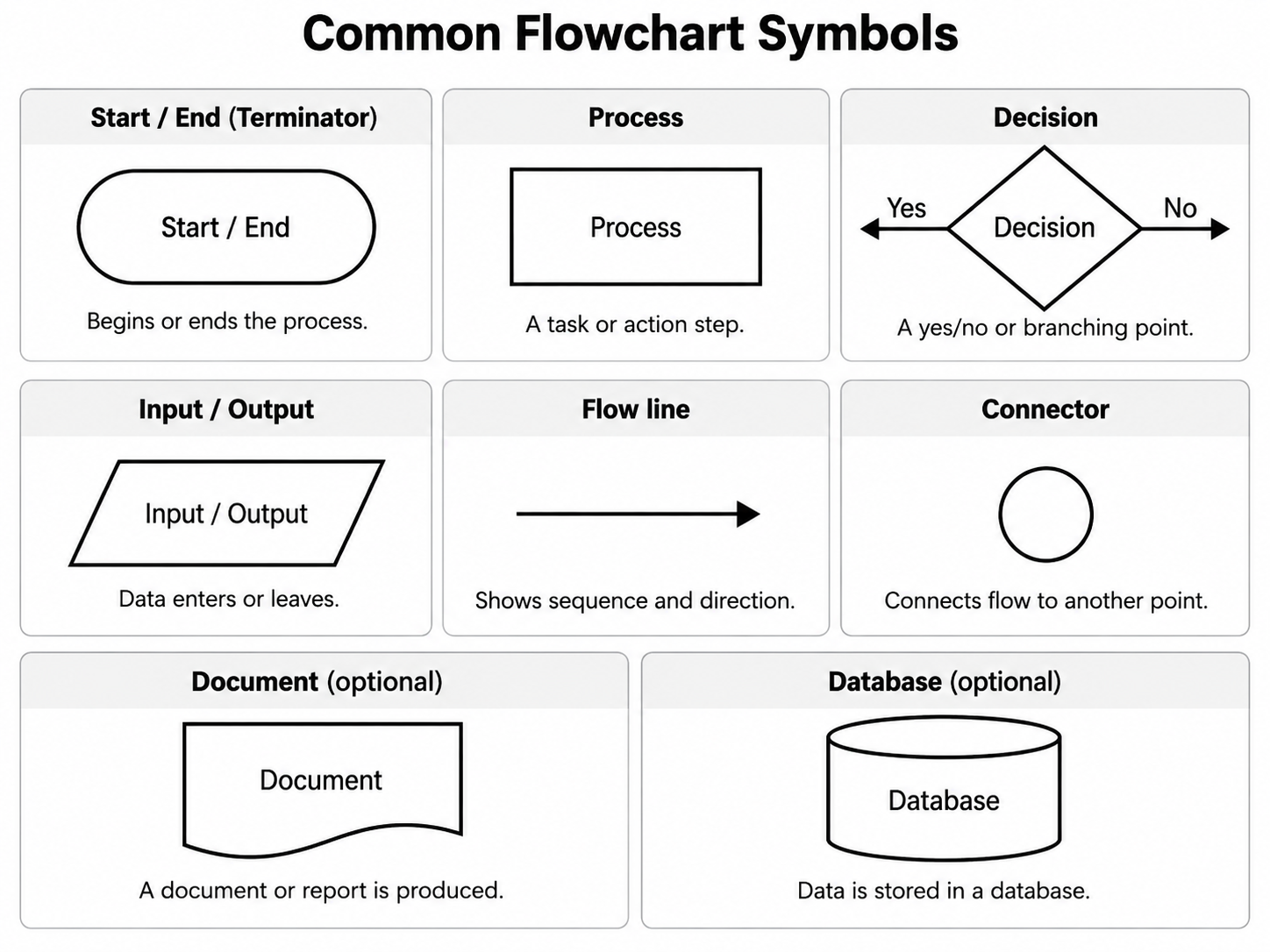
Reference: CQT BoK I
Q3.A team reviews the cause and effect diagram shown below before it starts collecting data.
Which entry has been placed on the wrong branch?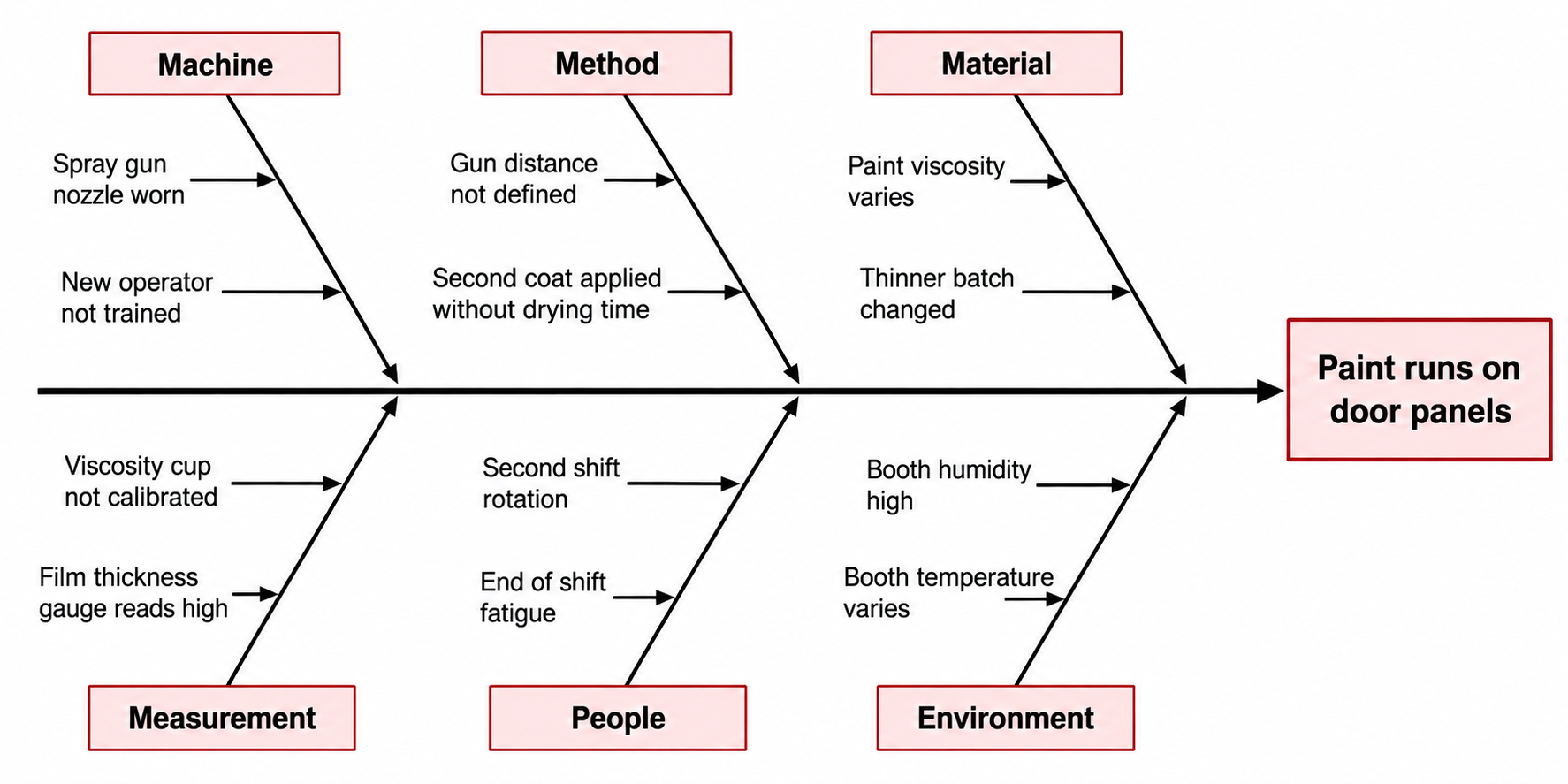
- A.New operator not trained, on the Machine branch✓ Correct answer
- B.Booth humidity high, on the Environment branch
- C.Paint viscosity varies, on the Material branch
- D.Film thickness gauge reads high, on the Measurement branch
Explanation
Each bone of the diagram holds causes of one kind. Training is something about the person doing the job, so it belongs on the People bone. The Machine bone is for the equipment itself, such as the worn nozzle already listed there.
The gauge entry is the nearest wrong answer, because a gauge is a piece of equipment and looks like a machine cause. It is placed correctly. Measurement covers everything about how the result is measured, including the instruments used, so a gauge that reads high belongs there.Reference: CQT BoK I
Want the other 22 questions in CQT - 1. Quality Concepts and Tools?
How well do you understand Quality Concepts and Tools
- 25 exam-style CQT questions focused on Quality Concepts and Tools
- Full explanation for every question
- Mobile friendly, no install required
- Instant feedback as you answer
Strengthen Your Understanding of Quality Concepts and Tools
Preparing for the ASQ Certified Quality Technician (CQT) exam?
This paid 25-question practice quiz focuses specifically on Quality Concepts and Tools, Section I of the CQT Body of Knowledge. ASQ's current CQT preparation outline identifies Section I as covering Quality Concepts, Quality Tools, and the ASQ Code of Ethics for Professional Conduct.
The questions include a practical mix of:
- Internal and external customers and suppliers
- Quality principles for products and processes
- Standards, requirements, and specifications
- Cost of quality
- Six Sigma concepts
- Lean concepts
- Continuous improvement techniques
- Problem-solving techniques
- Cause-and-effect diagrams
- Flowcharts and process maps
- Check sheets
- Pareto charts
- Scatter diagrams
- Control charts
- Histograms
- Selecting and interpreting quality tools
- ASQ Code of Ethics and professional conduct
- Workplace-based quality technician scenarios
- Plausible distractors based on common misunderstandings
Learn from Every Question
This quiz is offered in Review Mode, so you will see the correct answer and a clear explanation immediately after each response.
Each explanation helps you understand:
- Why the correct answer is right
- Which quality concept or tool is being tested
- Why the other options are less appropriate
- How the concept applies in a practical quality technician situation
- How similar concepts may appear in a CQT-style question
The goal is not simply to check your score. It is to help you understand how fundamental quality concepts, improvement methods, problem-solving techniques, quality tools, and professional conduct support effective quality control and improvement activities.
Part of the Paid CQT Practice Package
This 25-question quiz is included in the complete CQT Practice Test Package.
Use it to:
- Strengthen your understanding of fundamental quality concepts
- Distinguish standards, specifications, and customer requirements
- Classify cost-of-quality activities
- Apply Lean, Six Sigma, and continuous improvement concepts
- Select and interpret the seven basic quality tools
- Apply problem-solving techniques to workplace situations
- Recognize appropriate ethical and professional behavior
- Improve your readiness for the CQT exam
Ready to Test Your Quality Concepts and Tools Knowledge?
Complete the 25-question Review Mode quiz and use every incorrect answer as a guide for further study.
Start the CQT Quality Concepts and Tools Practice Quiz
What this quiz covers
- Quality Concepts and Tools
Questions about this practice test
Related CQT practice tests
- CQT Free Practice Questions (Review Mode)25 practice questionsReviewFreeView quiz
- CQT Full 100 Randomly Drawn Questions Mock Exam (240 Minutes)100 practice questionsExam · 240 minView quiz
- CQT Free Mock Exam (60 Minutes)25 practice questionsExam · 60 minFreeView quiz
- CQT - 2. Statistical Techniques25 practice questionsReviewView quiz
Want the full course, not just the questions?
Quality Gurus video courses cover the whole body of knowledge with worked examples, templates and downloadable notes — taught by Sandeep Kumar.
Browse Quality Gurus courses