
Free sample questions
2 questions from this set, shown in full with the correct answer and the reasoning behind it. Read them as a study resource.
Q1.Four risks have been plotted on a risk matrix.
Which risk requires the most urgent action?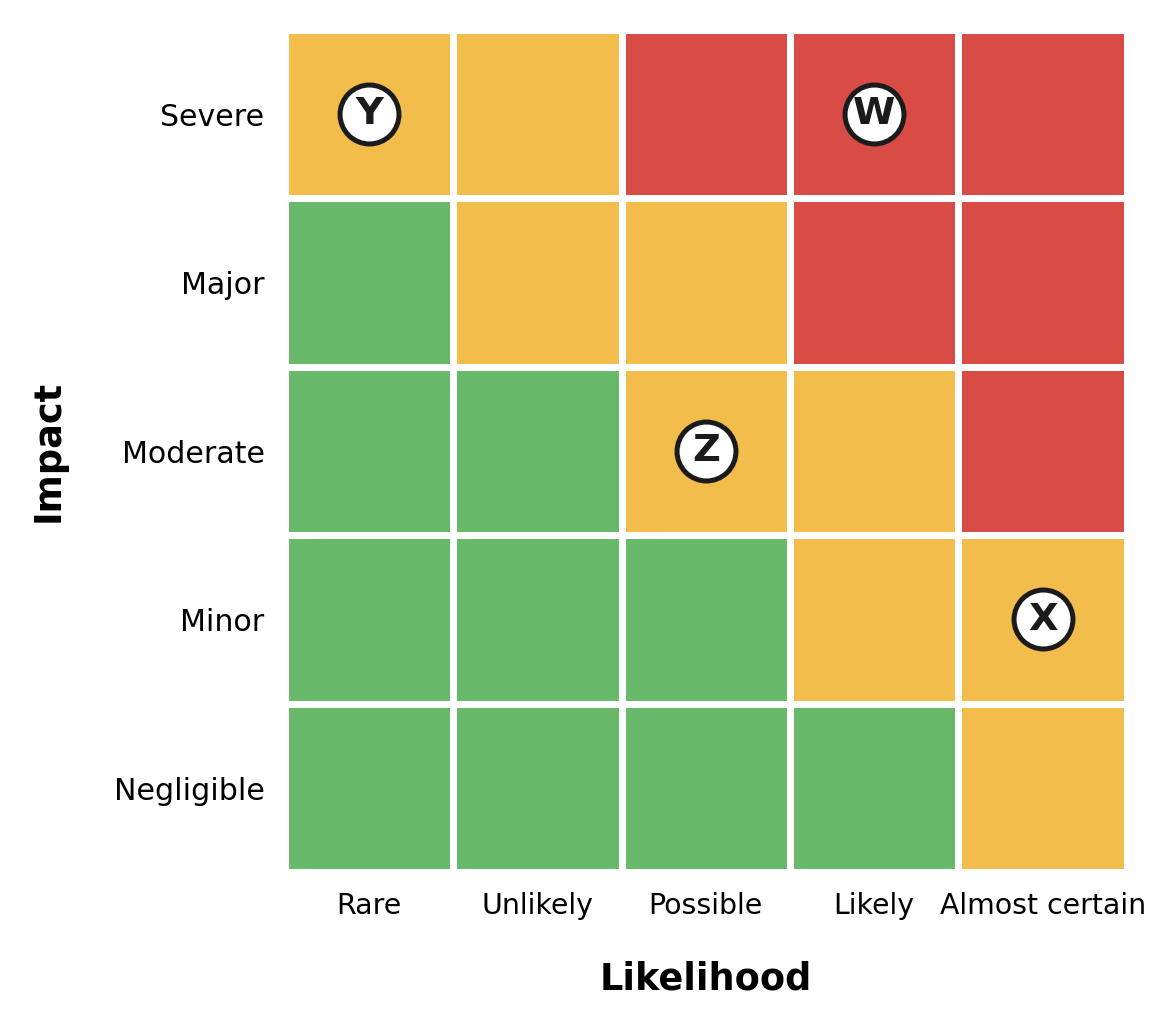
- A.Risk W, which is high on both likelihood and impact✓ Correct answer
- B.Risk X, because it is almost certain to occur
- C.Risk Y, because its impact would be severe and costly
- D.Risk Z, because it sits at the centre of the matrix
Explanation
A risk matrix combines two dimensions, and the cell that is high on both carries the greatest expected loss. W is the only marker in the red region.
The other three need different treatments rather than no treatment. X is almost certain but minor, so it is managed by reducing how often it happens. Y is rare but severe, which calls for contingency planning rather than day to day effort. Z is moderate on both and is monitored.
Picking a risk because it is extreme on one axis alone is the error the matrix exists to prevent.Reference: CQIA BoK III
Q2.A defect rate is plotted before and after a corrective action.
What should the team conclude?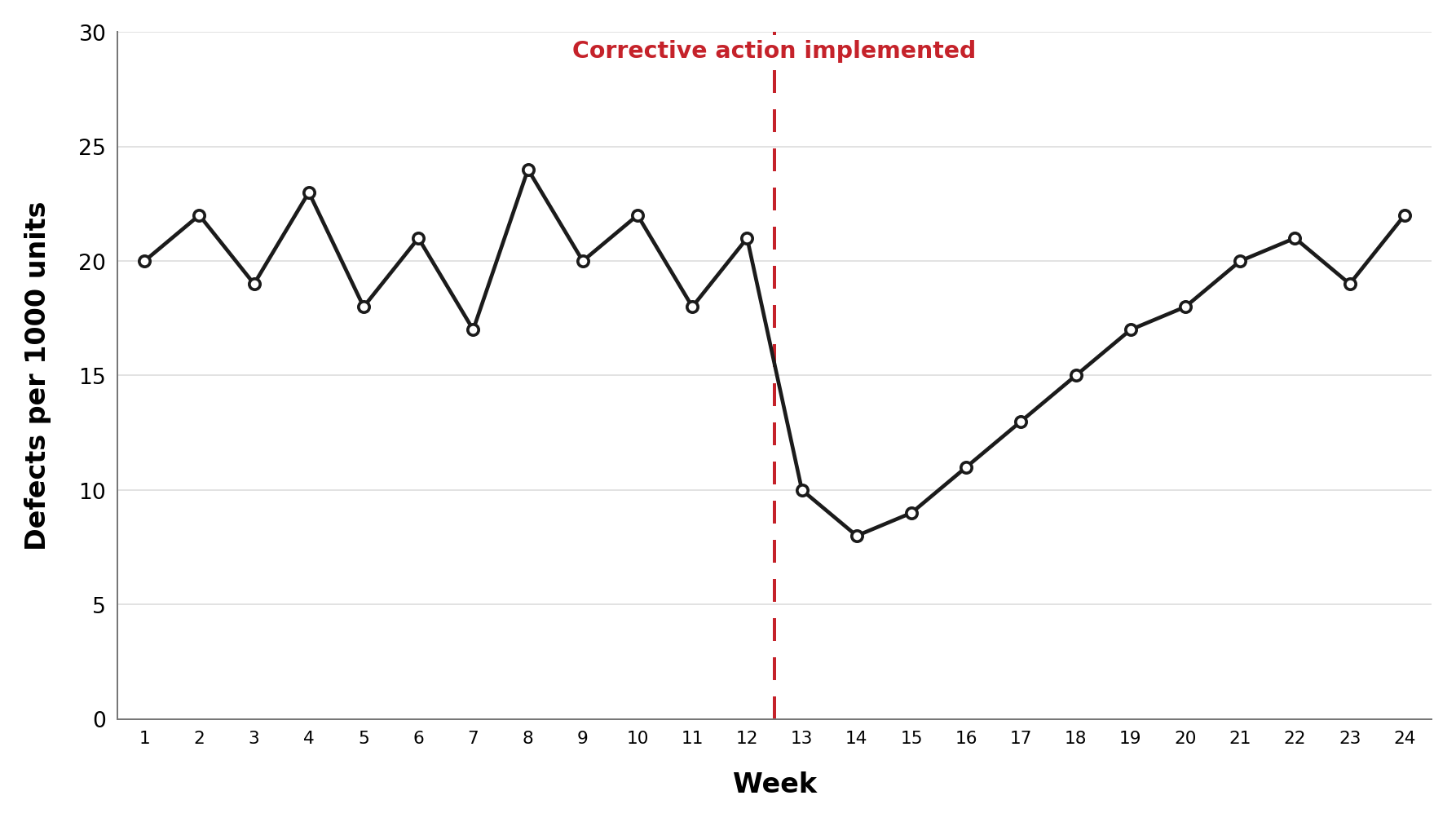
- A.The chart shows normal week to week variation with no real change
- B.The process is still improving and needs more time to settle
- C.The corrective action did not remove the cause and the problem has returned✓ Correct answer
- D.The corrective action succeeded and the process is now stable at a lower level
Explanation
The rate drops sharply after the action and then climbs back, ending in the same band it occupied before. Twenty four weeks of data show a temporary effect rather than a lasting one.
This decay pattern usually means one of two things. Either the action addressed a contributor rather than the root cause, or it was a change that depended on attention and the attention faded once the project ended.
Verifying effectiveness some weeks after implementation is what catches this. A team that checked at week sixteen would have declared success.Reference: CQIA BoK III
Want the other 23 questions in CQIA - 7. Root Cause and Risk?
How well do you understand Customer and Supplier Relationships
- 25 exam-style CQIA questions focused on Customer and Supplier Relationships
- Full explanation for every question
- Mobile friendly, no install required
- Instant feedback as you answer
Strengthen Your Understanding of Root Cause Analysis and Risk Management
Preparing for the ASQ Certified Quality Improvement Associate (CQIA) exam?
This paid 25-question practice quiz, titled Root Cause and Risk, focuses specifically on Section III.D: Root Cause Analysis and Section III.E: Risk Management within the CQIA Body of Knowledge.
The questions include a practical mix of:
- Purpose of root cause analysis
- Distinguishing symptoms from root causes
- Immediate correction and corrective action
- Preventing problem recurrence
- The 5 Whys technique
- Developing effective Why questions
- Recognizing unsupported conclusions
- Cause-and-effect diagrams
- Fishbone diagram categories
- Identifying potential causes
- Investigating and verifying causes
- Selecting an appropriate root cause tool
- Implementing correction and corrective action
- Evaluating corrective-action effectiveness
- Identifying and communicating risks
- Risk-based prioritization
- Failure modes and effects analysis
- Failure modes, effects, and causes
- Severity, occurrence, and detection
- Prioritizing potential failure risks
- Strengths, weaknesses, opportunities, and threats
- Internal and external SWOT factors
- Comparing FMEA and SWOT
- Prioritizing activities and projects based on risk
- Practical workplace scenarios
- Plausible distractors based on common misunderstandings
Learn from Every Question
This quiz is offered in Review Mode, so you will see the correct answer and a clear explanation immediately after each response.
Each explanation helps you understand:
- Why the correct answer is appropriate
- Which root cause or risk concept is being tested
- Why the other options are less suitable
- How to distinguish a symptom from a root cause
- How correction differs from corrective action
- When to use 5 Whys or a fishbone diagram
- When to use FMEA or SWOT
- How risk supports prioritization and decision-making
- How similar concepts may appear in a CQIA-style question
The goal is not simply to check your score. It is to develop a practical understanding of how to investigate problems, identify root causes, implement corrective actions, recognize risks, and prioritize improvement activities.
Part of the Paid CQIA Practice Package
This 25-question quiz is included in the complete CQIA Practice Test Package.
Use it to:
- Distinguish between symptoms and root causes
- Apply the 5 Whys technique
- Interpret cause-and-effect diagrams
- Differentiate correction from corrective action
- Recognize the importance of verifying potential causes
- Understand the basic purpose of FMEA
- Identify internal and external SWOT factors
- Select an appropriate risk-management tool
- Prioritize projects and actions based on risk
- Apply root cause and risk concepts to workplace situations
- Identify gaps in your knowledge
- Improve your readiness for the CQIA exam
Ready to Test Your Root Cause and Risk Knowledge?
Complete the 25-question Review Mode quiz and use every incorrect answer as a guide for further study.
Start the CQIA Root Cause and Risk Practice Quiz
What this quiz covers
- Quality Basics
Questions about this practice test
Related CQIA practice tests
- CQIA Free Practice Questions (Review Mode)25 practice questionsReviewFreeView quiz
- CQIA Full 100 Randomly Drawn Questions Mock Exam (180 Minutes)100 practice questionsExam · 240 minView quiz
- CQIA Free Mock Exam (60 Minutes)25 practice questionsExam · 60 minFreeView quiz
- CQIA - 2. Quality Gurus25 practice questionsReviewView quiz
Want the full course, not just the questions?
Quality Gurus video courses cover the whole body of knowledge with worked examples, templates and downloadable notes — taught by Sandeep Kumar.
Browse Quality Gurus courses