
Free sample questions
4 questions from this set, shown in full with the correct answer and the reasoning behind it. Read them as a study resource.
Q1.A company tracks its cost of poor quality over three quarters while running an improvement program.
All figures are in thousands of dollars. Which conclusion does the pattern best support?- A.The improvement program has increased total quality cost
- B.Prevention spending has reached the point of diminishing return
- C.Spending more on prevention is being repaid by lower failure cost✓ Correct answer
- D.The appraisal reduction is the main source of the total saving
Explanation
Prevention spending rose from to , an increase of . Failure cost fell from to , a drop of . The organization spent an extra and avoided , so prevention is paying for itself several times over.
Appraisal fell by only , so it cannot account for the saving. Total cost fell from to , so the program has not increased cost.
Diminishing return would show as failure cost flattening while prevention keeps rising, and the failure column is still dropping steeply.Reference: CQIA BoK I
Q2.A team wants to know where on a moulded panel surface defects are occurring, not just how many there are.
Which form of check sheet is most appropriate?- A.A defect location check sheet using a drawing of the panel✓ Correct answer
- B.A tally check sheet listing defect types by count
- C.A check sheet recording defects by shift and operator
- D.A check sheet recording the time each defect was found
Explanation
A defect location check sheet uses a picture or drawing of the item, and the recorder marks each defect where it appears. Clusters then become visible immediately.
This is often the fastest route to a cause. Defects concentrated along one edge point to handling or to a fixture; defects around a single feature point to the tool at that position.
Counting by type, shift, or time would all be useful, and none of them would show position, which is what the team asked for. See an example below: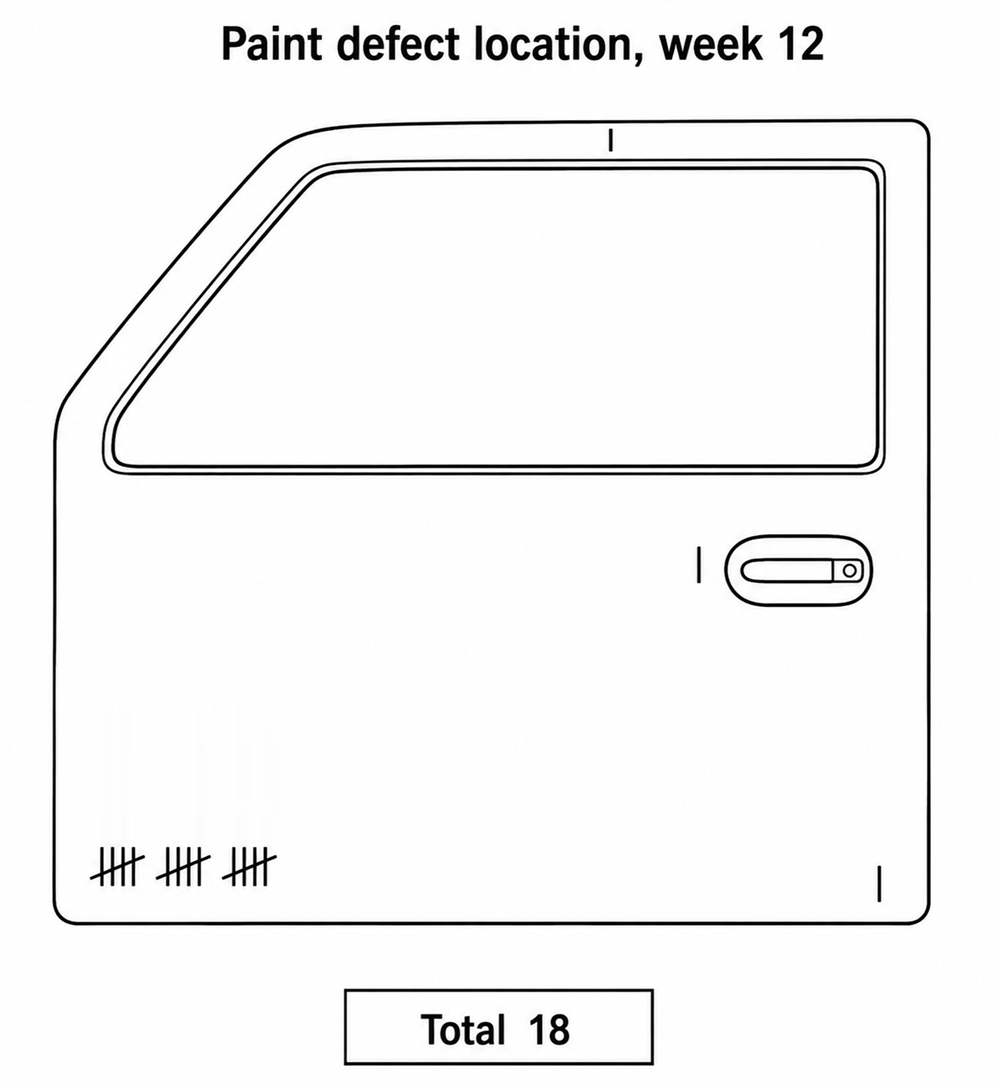
Reference: CQIA BoK III
Q3.A team places four items in a SWOT analysis.
Which item has been placed in the wrong quadrant?- A.Experienced technical staff
- B.Growing demand in a nearby market
- C.Pending change to environmental regulation
- D.New competitor entering the region✓ Correct answer
Explanation
A new competitor is outside the organization and is unfavourable, so it belongs under threats rather than weaknesses.
Weaknesses are internal: a skills gap, ageing equipment, a process that cannot hold tolerance. The organization can act on them directly.
The other three are placed correctly. Experienced staff is an internal strength, growing demand is an external opportunity, and a pending regulatory change is an external threat.Reference: CQIA BoK III
Q4.A purchasing manager is evaluating four suppliers for a machined component.
Which supplier has the highest weighted score?- A.Gamma
- B.Delta
- C.Beta✓ Correct answer
- D.Alpha
Explanation
A weighted score multiplies each rating by its weight and adds the results:
Working through the suppliers:
Beta is highest at . Alpha has the best quality rating of all four, which is why it draws the eye, but weak delivery and service pull its total to the bottom.Reference: CQIA BoK IV
Want the other 96 questions in CQIA Full 100 Randomly Drawn Questions Mock Exam (180 Minutes)?
Practise CQIA the way the exam actually asks it
- 100 exam-style CQIA questions randomly drawn from a pool
- Full explanation for every question (on completing the exam)
- Mobile friendly, no install required
- Each time you take this quiz, it draws random questions from the database
Full-Length CQIA Exam Simulation
Preparing for the ASQ Certified Quality Improvement Associate (CQIA) exam?
This full-length practice test includes 100 questions and a 180-minute time limit, giving you a realistic opportunity to test your knowledge, pacing, and exam strategy across the complete CQIA Body of Knowledge.
The current ASQ computer-based CQIA exam contains 110 questions, including 100 scored questions and 10 unscored pretest questions, with 3 hours and 18 minutes of exam time.
The simulation includes a balanced mix of:
- Quality concepts and principles
- Quality systems and organizational culture
- Customer and supplier relationships
- Team roles and communication
- Process management
- Process mapping
- Data collection
- Basic statistics
- Quality tools
- Problem solving
- Root cause analysis
- Corrective action
- Continuous improvement
- Lean concepts
- Improvement methods
- Workplace-based scenarios
- Short calculations and data interpretation
- Plausible distractors based on common misunderstandings
- Questions from all CQIA Body of Knowledge areas
Practise in Exam Mode
Answers and explanations are not shown while you are taking the test. You complete the full simulation first and review your results after submission.
During the test, you can:
- Move forward and backward between questions
- Change your answers
- Mark questions for later review
- Monitor the remaining time
- Review flagged and unanswered questions before submitting
This format helps you practise the skills required during the real exam, including time management, concentration, question interpretation, basic calculations, and reference-book navigation.
Review Your Results
After submitting the test, you will receive your score, the correct answers, and detailed explanations.
The results help you identify weak CQIA Body of Knowledge areas and decide where to focus your final preparation.
Reviewing incorrect answers can show whether you need additional study in areas such as quality concepts, process management, teamwork, quality tools, basic statistics, root cause analysis, corrective action, or continuous improvement.
Included in the Paid CQIA Practice Package
This full-length simulation is part of the complete CQIA Practice Test Package.
It is intended for candidates who have already studied the material and are ready to assess their overall exam readiness under timed conditions.
Start the Full-Length CQIA Exam Simulation
What this quiz covers
- Continuous Improvement Techniques
- Supplier Relationship
- Customer Relationship
- Quality Basics
- Team Basics
Questions about this practice test
Related CQIA practice tests
Want the full course, not just the questions?
Quality Gurus video courses cover the whole body of knowledge with worked examples, templates and downloadable notes — taught by Sandeep Kumar.
Browse Quality Gurus courses