
Free sample questions
5 questions from this set, shown in full with the correct answer and the reasoning behind it. Read them as a study resource.
Q1.During a walk of the shop floor a team records four observations.
Which observation is an example of the waste of motion?- A.Observation 1
- B.Observation 2
- C.Observation 3✓ Correct answer
- D.Observation 4
Explanation
Motion is unnecessary movement of the worker's body within the workstation, so turning and reaching on every cycle is motion. Observation 1 is the primary foil because it is also movement, but it moves the product rather than the person, which makes it the waste of transportation.Reference: CSSGB BoK I
Q2.A failure mode currently carries severity 7, occurrence 6 and detection 5. Three corrective actions have been proposed, and the ratings each one would leave behind are shown below.
Which ranking orders the three actions from lowest to highest revised risk priority number?- A.C, A, B
- B.A, B, C
- C.B, A, C✓ Correct answer
- D.B, C, A
Explanation
The risk priority number is the product of the three ratings:
Applying it to each proposal:
So the order is B, then A, then C, against a current value of . Action C is the trap: cutting severity feels like the strongest possible move, but leaving occurrence and detection untouched leaves it with the highest revised RPN of the three.Reference: CSSGB BoK I
Q3.An interrelationship digraph drawn for chronic schedule slippage is shown below.
Which issue should the team attack as the root driver?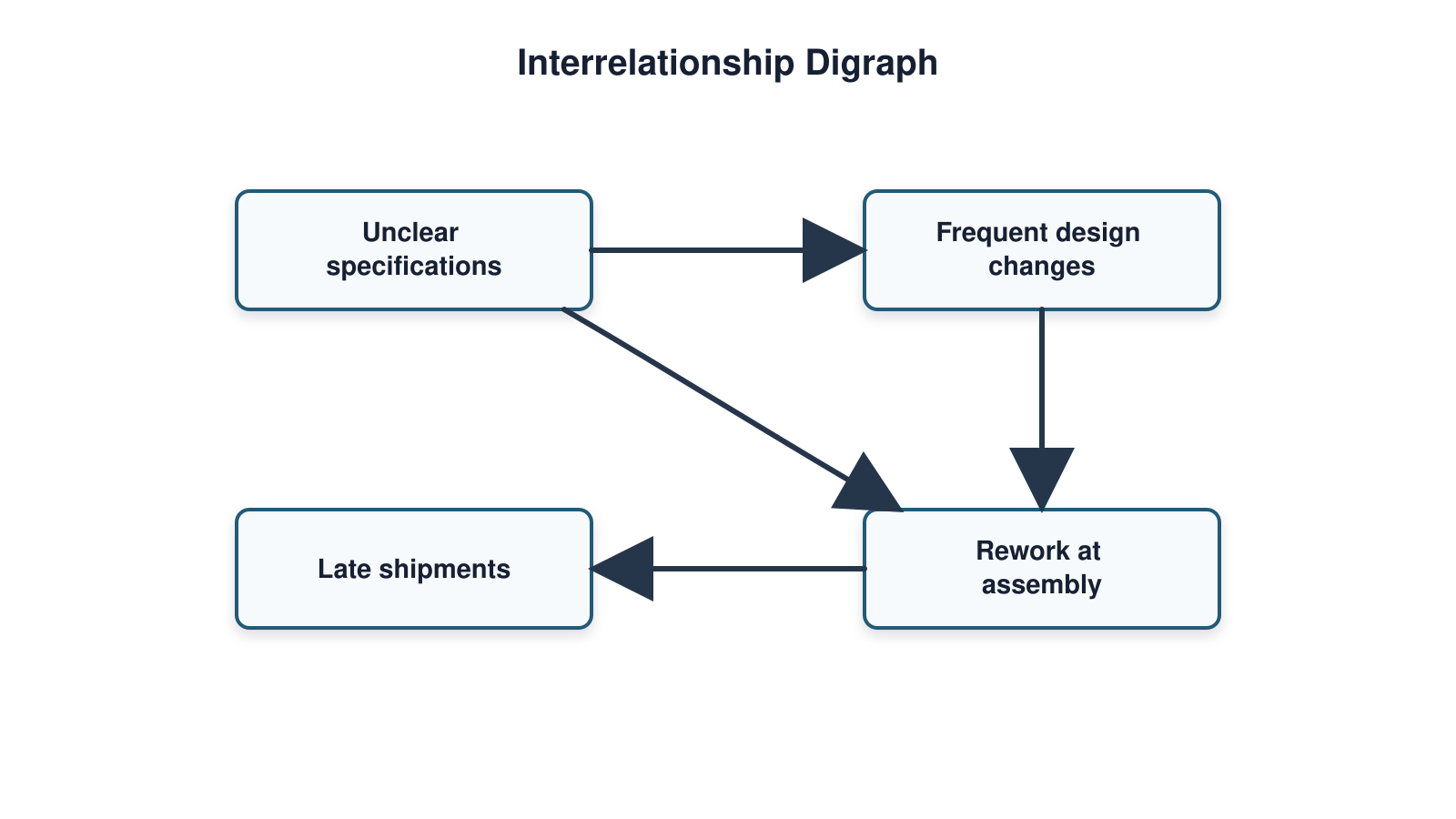
- A.Frequent design changes
- B.Rework at assembly
- C.Unclear specifications✓ Correct answer
- D.Late shipments
Explanation
In an interrelationship digraph the driver is the node with the most arrows leaving it and none arriving, because it causes other issues without being caused by any of them. Rework at assembly is the primary foil: it has the most arrows arriving, which makes it look central, but a node dominated by incoming arrows is an outcome, and attacking it treats a symptom.Reference: CSSGB BoK II
Q4.A green belt reviews the flowchart below during a documentation review.
Which defect in the flowchart should be corrected?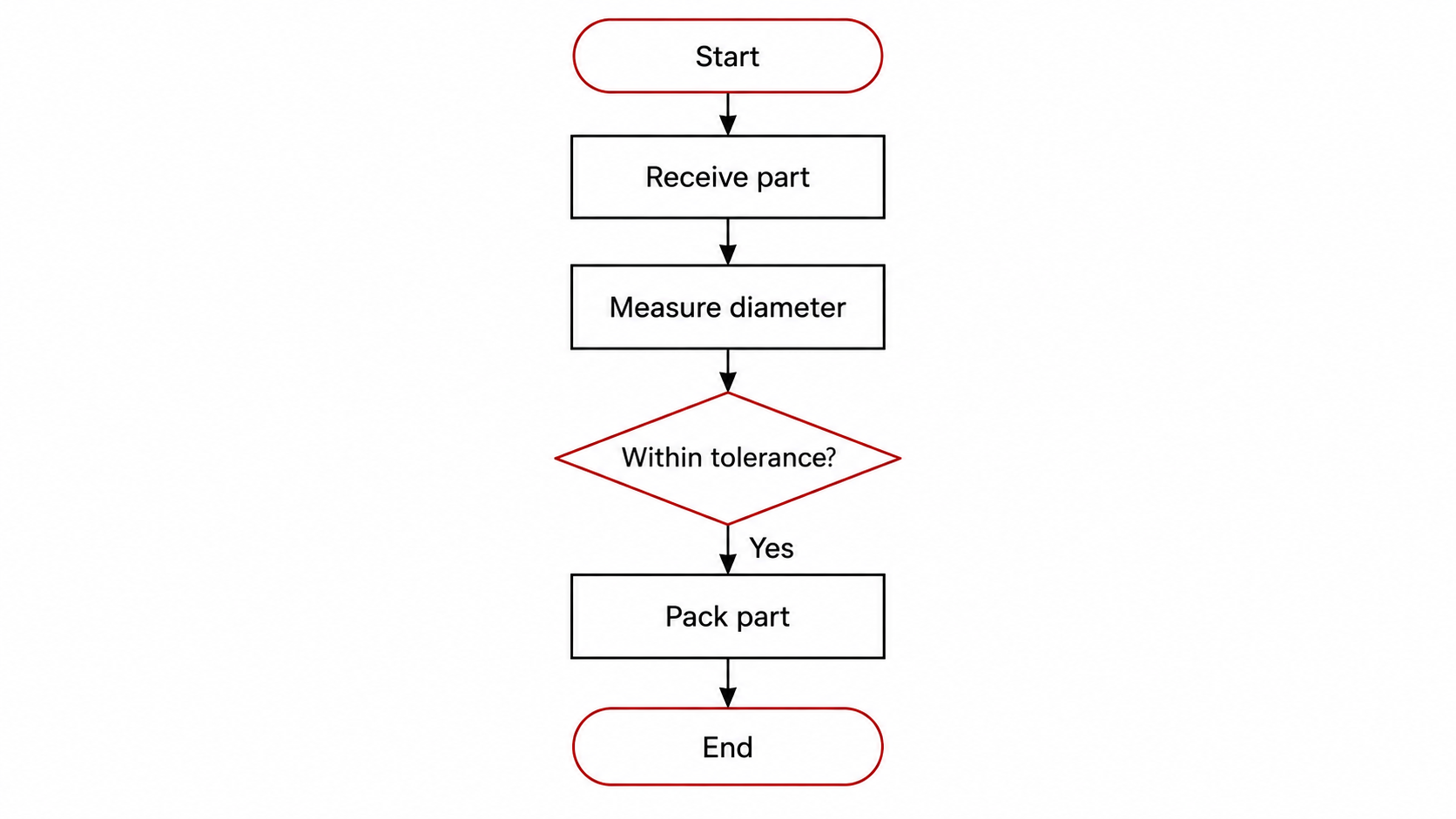
- A.A process step is drawn as a parallelogram rather than a rectangle
- B.A terminator symbol is missing from the end of the chart
- C.A decision symbol has only one exit path✓ Correct answer
- D.An inspection step is drawn as a rectangle rather than a diamond
Explanation
A decision symbol asks a yes or no question, so it must have at least two exit paths; a diamond with one exit means the chart has no route for the nonconforming part and the rework loop has been left off the map. Reading the measurement step as a missing diamond is the tempting alternative, but measuring is an activity and belongs in a rectangle. The decision that follows it is what needs both branches.Reference: CSSGB BoK III
Q5.An chart has a centre line at , an upper control limit at and a lower control limit at , so one sigma on the chart equals . The eight most recent subgroup means plotted as follows.
Which run rule is violated?- A.Four of five consecutive points beyond one sigma on the same side of the centre line
- B.Two of three consecutive points beyond two sigma on the same side of the centre line✓ Correct answer
- C.A single point falling beyond a three sigma control limit
- D.Eight consecutive points falling on the same side of the centre line
Explanation
The zone boundaries follow from the sigma value given:
Subgroups 4, 5 and 6 are consecutive, and two of them, and , sit beyond the upper two sigma line, which fires the zone A rule. The one sigma line is at , and no window of five consecutive points holds four beyond it, so the four of five rule is the primary foil rather than the answer. No point reaches , and subgroups 2 and 8 fall below the centre line, so neither of the remaining rules applies.Reference: CSSGB BoK VI
Want the other 95 questions in CSSGB Full 100 Randomly Drawn Questions Mock Exam (240 Minutes)?
Practise CSSGB the way the exam actually asks it
- 100 exam-style CSSGB questions randomly drawn from a pool
- Full explanation for every question (on completing the exam)
- Mobile friendly, no install required
- Each time you take this quiz, it draws random questions from the database
Full-Length CSSGB Exam Simulation
Preparing for the ASQ Certified Six Sigma Green Belt exam?
This full-length practice test includes 100 questions and a 240-minute time limit, giving you a realistic opportunity to test your knowledge, pacing, and exam strategy across the complete CSSGB Body of Knowledge.
The simulation includes a balanced mix of:
- Concept-based questions
- Practical Six Sigma project scenarios
- Statistical and analytical calculations
- Lean and DMAIC applications
- Plausible distractors based on common misunderstandings
- Questions from all six CSSGB Body of Knowledge sections
Practise in Exam Mode
Answers and explanations are not shown while you are taking the test. You complete the full simulation first and review your results after submission.
During the test, you can:
- Move forward and backward between questions
- Change your answers
- Mark questions for later review
- Monitor the remaining time
- Review flagged and unanswered questions before submitting
This format helps you practise the same skills needed during the real exam, including time management, concentration, question selection, calculation strategy, and reference-book navigation.
Review Your Results
After submitting the test, you will receive your score, correct answers, and detailed explanations. The results help you identify weak Body of Knowledge areas and decide where to focus your final preparation.
Included in the Paid CSSGB Practice Package
This full-length simulation is part of the complete CSSGB Practice Test Package. It is intended for candidates who have already studied the material and are ready to assess their overall exam readiness under timed conditions.
Start the Full-Length CSSGB Exam Simulation
What this quiz covers
- Overview: Six Sigma and the Organization
- Define Phase
- Measure Phase
- Analyze Phase
- Improve Phase
- Control Phase
Questions about this practice test
Related CSSGB practice tests
Want the full course, not just the questions?
Quality Gurus video courses cover the whole body of knowledge with worked examples, templates and downloadable notes — taught by Sandeep Kumar.
Browse Quality Gurus courses