
Free sample questions
6 questions from this set, shown in full with the correct answer and the reasoning behind it. Read them as a study resource.
Q1.A steering committee scores four candidate projects against weighted criteria before the next deployment wave.
Which project should be launched first as a DMAIC project?- A.P, because strategic fit and benefit together carry the most weight
- B.R, because good data and high benefit make the analysis tractable
- C.Q, because a strong strategic fit is paired with obtainable data✓ Correct answer
- D.S, because it scores highest on every one of the three criteria
Explanation
S has the best score sheet and a known cause, which disqualifies it: there is nothing to discover, so it should simply be implemented. Among the rest, Q at beats P at on tie-break because P cannot be measured, and R has the weakest strategic linkage. The lesson is that the screening question comes before the scoring.Reference: CSSBB BoK I
Q2.A plant reports its cost of quality before and after a two-year prevention programme.
All figures are in thousands. What does this profile demonstrate?- A.The programme failed, since prevention spending rose by 167 percent
- B.External failure fell fastest, so the gain came from better inspection
- C.Prevention spending of k bought a k reduction in failure cost✓ Correct answer
- D.Total quality cost fell mainly because appraisal spending was cut back
Explanation
Failure cost fell from 420 to 180, a reduction of 240, while prevention rose by 50 and appraisal fell by 20:
This is the classic cost of quality argument: money moved upstream returns several times over, and judging prevention by its percentage growth rather than by what it bought is exactly the mistake that keeps quality budgets misallocated.Reference: CSSBB BoK II
Q3.A team builds a SIPOC for a recruitment process and produces the following.
Which entry is misplaced, and where does it belong?- A.Signed contract, which is a customer record rather than an output
- B.HR system, which is a repository rather than a genuine customer
- C.Time to hire, which is a process measure rather than an input✓ Correct answer
- D.Referrals, which is a channel rather than a supplier of anything
Explanation
Inputs are the things the process consumes and transforms; time to hire is a metric describing how the process performs and does not belong in any of the five columns. Referrals genuinely supply candidates, the signed contract is a legitimate output, and a downstream system that receives and acts on the output is a reasonable internal customer.Reference: CSSBB BoK IV
Q4.A project network has the activities below, with durations in days.
How much total float does activity B have?- A.0 days
- B.3 days
- C.5 days
- D.1 day✓ Correct answer
Explanation
Compare the two paths through the network:
The critical path runs through C and E at 20 days, so the B and D branch carries one day of float. Adding resources to B would therefore buy nothing until that single day is consumed.Reference: CSSBB BoK IV
Q5.A gage R and R study on a critical dimension returns the following.
What is the correct disposition of this measurement system?- A.Acceptable, since total gage R and R sits below the 30 percent threshold
- B.Unacceptable, since repeatability alone exceeds the 10 percent threshold
- C.Acceptable, since part-to-part variation dominates the total at 96 percent
- D.Marginal, and unfit for judging individual parts until ndc reaches 5✓ Correct answer
Explanation
Two criteria must both be satisfied, and they disagree here: 28% study variation falls in the marginal band, while an ndc of 4 sits below the minimum of 5 required to distinguish individual parts reliably. Quoting only the percentage is how a system like this gets signed off, and the ndc is what reveals it cannot resolve the parts it is being used to accept.Reference: CSSBB BoK V
Q6.A histogram of fill weights is shown against the specification limits.
What does the picture indicate, and what should be done first?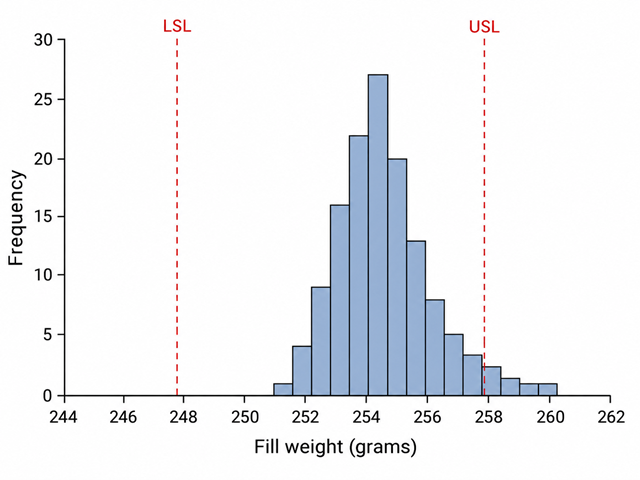
- A.The specification is too tight, so a tolerance review should be requested
- B.The process is off centre, so adjust the mean before reducing variation✓ Correct answer
- C.The process spread is too wide, so variation reduction is the first priority
- D.The process is bimodal, so two streams should be separated and charted apart
Explanation
The distribution is comfortably narrower than the tolerance and is simply sitting too high, so every defect is at the upper limit while the lower half of the tolerance is unused. Centring is usually a setting adjustment and is far cheaper than a variation reduction project, which is why reading the picture correctly changes what the team does next.Reference: CSSBB BoK V
Want the other 19 questions in CSSBB Free Mock Exam (60 Minutes)?
Practise CSSBB the way the exam actually asks it
- 25 exam-style CSSBB questions
- Full explanation for every question
- Mobile friendly, no install required
- Timed exam simulation
Test Your CSSBB Readiness in Exam Mode
Preparing for the ASQ Certified Six Sigma Black Belt exam?
Take this free 25-question practice test in Exam Mode and experience a more realistic exam-style environment before moving to the full CSSBB practice package.
The test includes a balanced mix of:
- Concept-based questions
- Practical workplace scenarios
- Short calculations
- Plausible distractors and common exam traps
Practise Under Exam-Like Conditions
In Exam Mode, answers and explanations are not shown after each question. You complete the test first and review your results only after submitting it.
You can:
- Move forward and backward between questions
- Change your answers before submission
- Mark questions for later review
- Monitor your remaining time
- Review all flagged and unanswered questions before finishing
This helps you practise pacing, decision-making, and time management in a format closer to the computer-based CSSBB exam.
Review Your Performance at the End
After submitting the test, you will receive your score, correct answers, and explanations. Each question is linked to the relevant CSSBB Body of Knowledge area so you can identify where further study is needed.
Free and No Registration Required
The 25-question Exam Mode test is completely free and can be taken without creating an account.
Use it to:
- Assess your current CSSBB readiness
- Practise working under time pressure
- Improve your question-navigation strategy
- Identify weak Body of Knowledge areas
- Experience the format of the full practice package
Ready for a More Realistic CSSBB Practice Experience?
Take the free 25-question Exam Mode test and see how well you perform when feedback is withheld until the end.
Take the Free CSSBB Exam Mode Practice Test
What this quiz covers
- Analyze
- Control
- Define
- Design For Six Sigma (DFSS) Framework and Methodologies
- Improve
- Measure
- Organization-wide Planning and Deployment
- Organizational Process Management and Measures
- Team Management
Questions about this practice test
Related CSSBB practice tests
- CSSBB Free Practice Questions (Review Mode) 25 practice questionsReviewFreeView quiz
- CSSBB Full 150 Randomly Drawn Questions Mock Exam (240 Minutes)150 practice questionsExam · 240 minView quiz
- CSSBB Practice Questions (Review Mode) - 1. Lean Tools25 practice questionsReviewView quiz
- CSSBB Practice Questions (Review Mode) - 2. Probability Distributions25 practice questionsReviewView quiz
Want the full course, not just the questions?
Quality Gurus video courses cover the whole body of knowledge with worked examples, templates and downloadable notes — taught by Sandeep Kumar.
Browse Quality Gurus courses