
Free sample questions
6 questions from this set, shown in full with the correct answer and the reasoning behind it. Read them as a study resource.
Q1.What is the formula for calculating availability?
- A.
- B.
- C.✓ Correct answer
- D.
Explanation
Availability is the fraction of total time the system is up:
represents uptime and represents downtime, so the denominator is total time. is the complement, the unavailability.Reference: CQE BoK III
Q2.What is the probability of a system with an MTBF of 10 hours failing within the first 2 hours of operation?
- A.0.18✓ Correct answer
- B.0.63
- C.0.82
- D.0.997
Explanation
With a constant failure rate, the probability of failing by time is the cumulative distribution function, which is one minus the reliability:
So the probability is about . The value is the complement, , which is the probability the system survives the first 2 hours. This formula applies only in the constant failure rate region of the bathtub curve.Reference: CQE BoK III
Q3.In a hospital, of patients have diabetes, have high blood pressure, and have both conditions.
If a patient is chosen at random, what is the probability that the patient has neither of these two conditions?- A.
- B.
- C.✓ Correct answer
- D.
Explanation
Let be the event 'has diabetes' and be the event 'has high blood pressure', so , and . The addition rule gives:
Having neither condition is the complement of the union:
The foil comes from forgetting to add back the overlap.Reference: CQE BoK VI
Q4.A company wants to determine if there is a significant difference in the average number of defects in products produced on three different machines. They perform an ANOVA and construct the following ANOVA table.
What is the missing value for the Sum of Squares in the ANOVA table?
- A.60✓ Correct answer
- B.80
- C.100
- D.120
Explanation
The sums of squares are additive: Total = + . With a total of 300 and of 240:Reference: CQE BoK VI
Q5.Four improvement projects compete for a single funding slot.
Ranking on benefit-cost ratio over the full project life, which project should be funded first?- A.Project P1
- B.Project P2
- C.Project P3✓ Correct answer
- D.Project P4
Explanation
Benefit-cost ratio compares lifetime benefit with cost:
P2 is the primary foil because it has the largest annual benefit, but its ratio is , below , so it destroys value over its short life. P4 has the largest net benefit at but a ratio of only , and P1 has the largest total benefit at with a ratio of ; when funding is the constraint, the ratio decides.Reference: CQE BoK I
Q6.At the end of week 8 a project manager reviews the schedule below, in which the shaded portion of each bar shows the work already completed.
Which task requires corrective action for schedule slippage?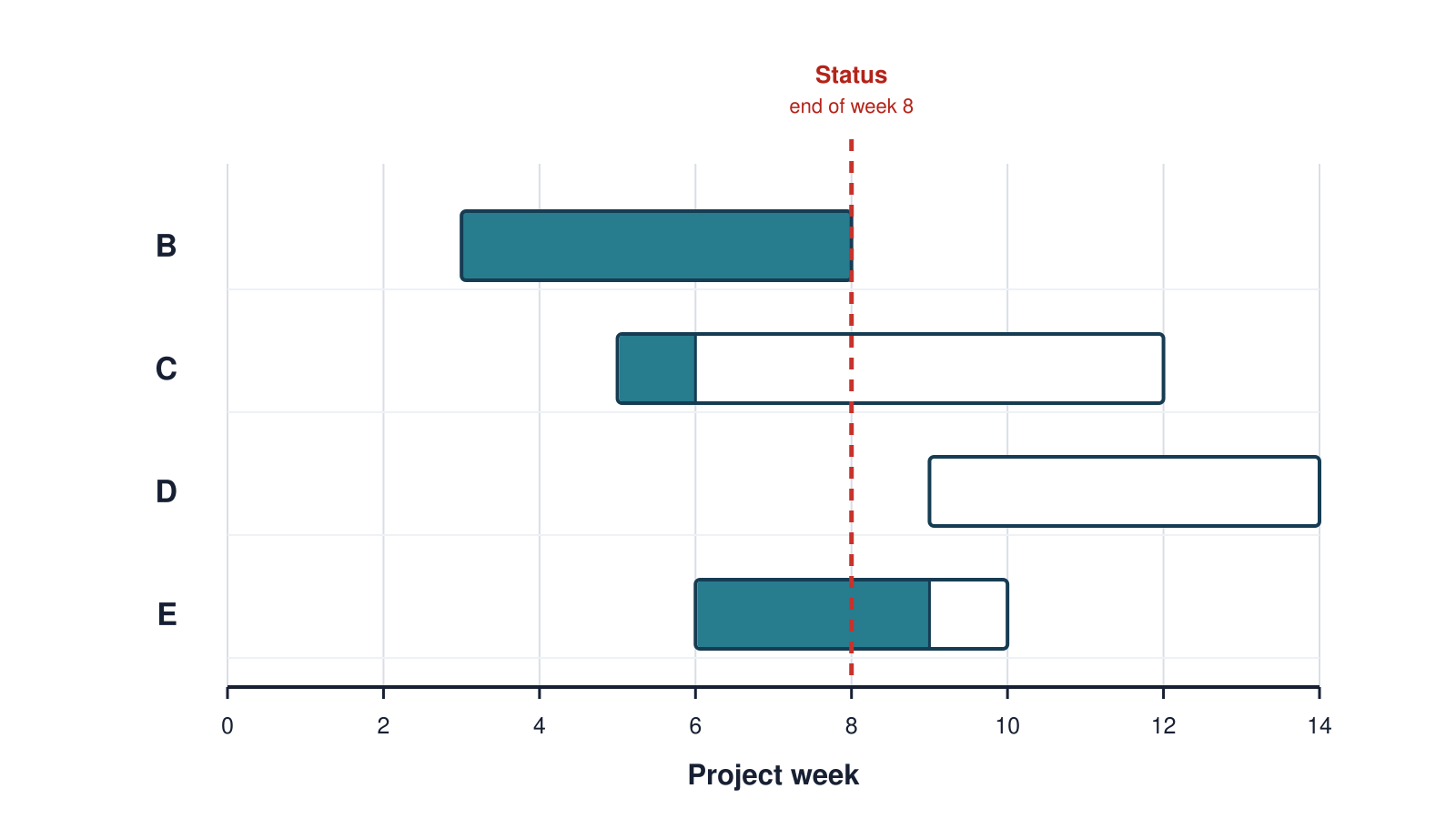
- A.Task B
- B.Task C✓ Correct answer
- C.Task D
- D.Task E
Explanation
A task is behind only when its shading stops short of the status line while its bar extends past it; Task C should be complete through week 8 but is shaded only to week 6, a two-week slip. Task D is the primary foil because nothing is shaded at all, but its planned start is week 9, so at the status date it is not yet due to begin.Reference: CQE BoK I
Want the other 154 questions in CQE Full 160 Questions Mock Exam (300 Minutes)?
Practise CQE the way the exam actually asks it
- 160 exam-style CQE questions randomly drawn from a pool
- Full explanation for every question (on completing the exam)
- Mobile friendly, no install required
- Each time you take this quiz, it draws random questions from the database
Full-Length CQE Exam Simulation
Preparing for the ASQ Certified Quality Engineer exam?
This full-length practice test includes 160 questions and a 300-minute time limit, giving you a realistic opportunity to test your knowledge, pacing, and exam strategy across the complete CQE Body of Knowledge.
The simulation includes a balanced mix of:
- Concept-based questions
- Practical workplace scenarios
- Statistical and quality-engineering calculations
- Plausible distractors based on common misunderstandings
- Questions from all CQE Body of Knowledge sections
Practise in Exam Mode
Answers and explanations are not shown while you are taking the test. You complete the full simulation first and review your results after submission.
During the test, you can:
- Move forward and backward between questions
- Change your answers
- Mark questions for later review
- Monitor the remaining time
- Review flagged and unanswered questions before submitting
This format helps you practise the same skills needed during the real exam, including time management, concentration, question selection, and reference-book navigation.
Review Your Results
After submitting the test, you will receive your score, correct answers, and detailed explanations. The results help you identify weak topics and decide where to focus your final preparation.
Included in the Paid CQE Practice Package
This full-length simulation is part of the complete CQE Practice Test Package. It is intended for candidates who have already studied the material and are ready to test their overall exam readiness under timed conditions.
Start the Full-Length CQE Exam Simulation
What this quiz covers
- Continuous Improvement
- Management and Leadership
- Product and Process Control
- Product, Process, and Service Design
- Quantitative Methods and Tools
- Risk Management
- The Quality System
Questions about this practice test
Related CQE practice tests
- CQE Free Practice Questions (Review Mode) 30 practice questionsReviewFreeView quiz
- CQE Free Mock Exam (60 Minutes)20 practice questionsExam · 60 minFreeView quiz
- CQE Practice Questions (Review Mode) - 2. Quality Tools25 practice questionsReviewView quiz
- CQE Practice Questions (Review Mode) - 1. Reliability20 practice questionsReviewView quiz
Want the full course, not just the questions?
Quality Gurus video courses cover the whole body of knowledge with worked examples, templates and downloadable notes — taught by Sandeep Kumar.
Browse Quality Gurus courses