
Free sample questions
5 questions from this set, shown in full with the correct answer and the reasoning behind it. Read them as a study resource.
Q1.A gauge study on a coating thickness meter returns the output below, with total study variation of mm.
How should this measurement system be judged?- A.Marginal, since gauge variation is about of study variation
- B.Acceptable, since gauge variation is below of study variation
- C.Unacceptable, since gauge variation is about of study variation✓ Correct answer
- D.Unacceptable, since gauge variation is about of study variation
Explanation
The two components combine through their variances:
The percentage of study variation follows:
Above the system is normally rejected, so it is unacceptable. The option is the trap, produced by adding the two standard deviations instead of combining their variances.Reference: CCQM BoK II
Q2.The control chart below covers the first twenty subgroups of a concrete strength monitoring programme.
What is the correct interpretation?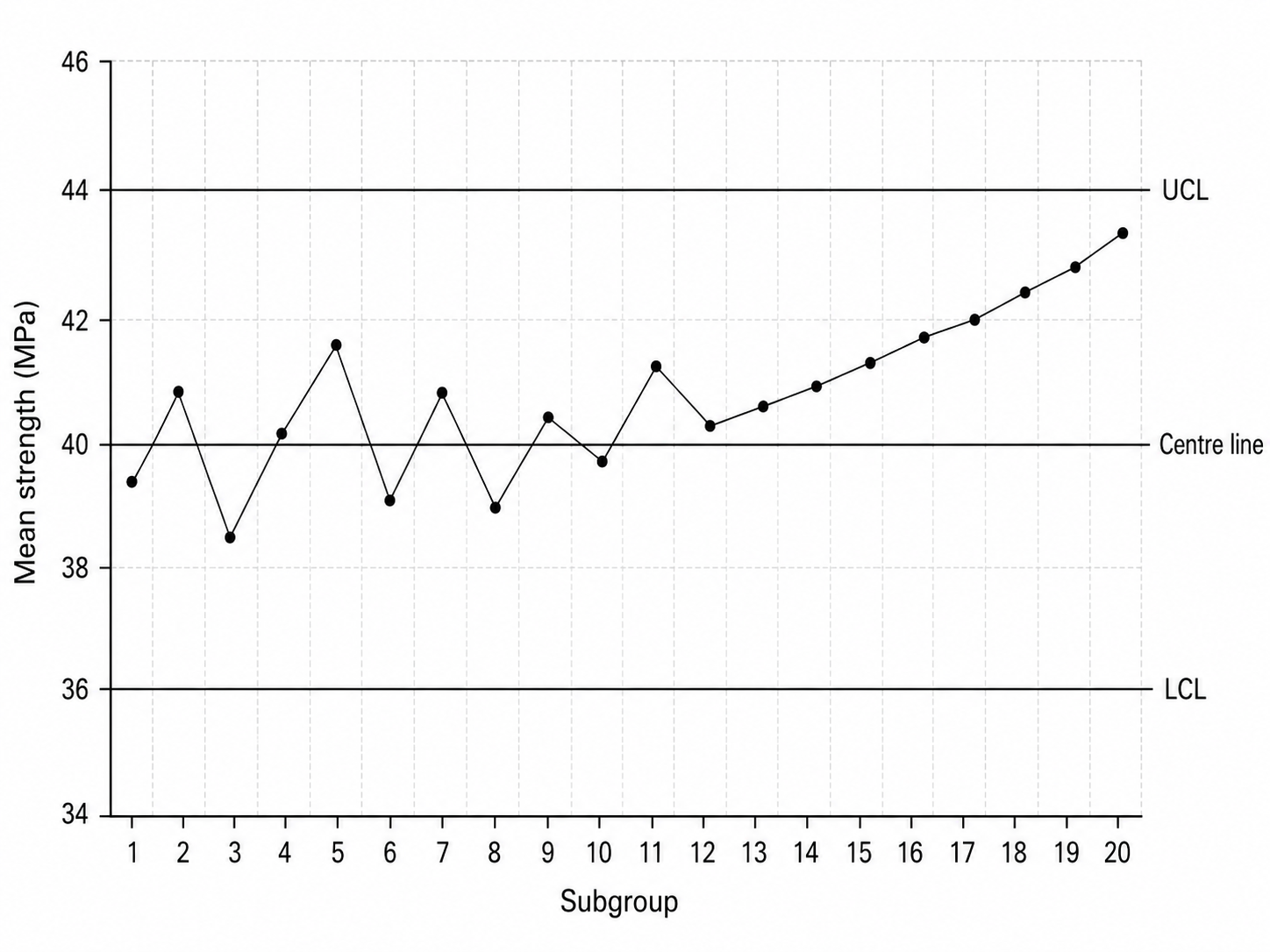
- A.The process is in control, since no point falls outside the control limits
- B.A trend is present, so the assignable cause should be investigated now✓ Correct answer
- C.The process is out of control, since points exceed the upper control limit
- D.The control limits should be recalculated to reflect the recent subgroups
Explanation
A run of nine consecutive rising points is a recognised out-of-control pattern in its own right, so the cause should be found before a point breaches a limit. The in-control reading is the primary foil: it applies the single most familiar rule correctly, but the limit rule is only one of several, and relying on it alone discards the early warning the trend provides.Reference: CCQM BoK II
Q3.Mill certificates for four heats of reinforcing bar are summarised below. The specification requires a minimum yield of ksi, a minimum tensile of ksi, a minimum elongation of , and an actual tensile to actual yield ratio of at least .
Which heat fails to conform, and why?- A.Heat C, because its tensile to yield ratio is below ✓ Correct answer
- B.Heat C, because its yield strength exceeds the stated minimum
- C.Heat B, because its tensile to yield ratio is below
- D.Heat D, because its elongation sits at the stated minimum
Explanation
The ratio criterion compares the two measured strengths of the same heat:
Substituting each heat:
Only Heat C falls below , and it does so while passing both absolute strength limits, which is why reading the strength columns on their own misses it. Heat D is the primary foil: its elongation of is the lowest in the table, but meeting a stated minimum exactly is conformance, not failure.Reference: CCQM BoK V
Q4.The monthly quality report carries the inspection data below.
Which month shows the worst quality performance?- A.Month 3
- B.Month 2
- C.Month 4✓ Correct answer
- D.Month 1
Explanation
Performance across periods of unequal workload must be expressed as a rate rather than a count:
Substituting each month:
Month 4 is worst at defects per hundred items. Month 1 is the trap: it has the largest raw count, but it also has the largest inspection volume, so its rate is the second lowest of the four.Reference: CCQM BoK V
Q5.Activities have been mapped to the five level commissioning framework, and one entry is placed in the wrong level.
Which entry is placed in the wrong level?- A.Valve actuator receipt verification
- B.Chiller works performance test before shipment✓ Correct answer
- C.Ductwork installation verification
- D.Fire alarm to air handling interface test
Explanation
A performance test carried out at the manufacturer's works before shipment is the factory acceptance test, which is level 1, not the level 4 verification of installed equipment in operation. The fire alarm interface entry is the primary foil: it also involves operating equipment and could be mistaken for level 4, but it exercises two systems together, which is precisely what level 5 integrated system testing means.Reference: CCQM BoK V
Want the other 145 questions in CCQM Full 150 Randomly Drawn Questions Mock Exam (240 Minutes)?
Practise CCQM the way the exam actually asks it
- 150 exam-style CCQM questions randomly drawn from a pool
- Full explanation for every question (on completing the exam)
- Mobile friendly, no install required
- Each time you take this quiz, it draws random questions from the database
Full-Length CCQM Exam Simulation
Preparing for the ASQ Certified Construction Quality Manager (CCQM) exam?
This full-length practice test includes 150 questions and a 240-minute time limit, giving you a realistic opportunity to test your knowledge, pacing, and exam strategy across the complete CCQM Body of Knowledge.
The simulation includes a balanced mix of:
- Concept-based questions
- Construction quality management scenarios
- Contract, design, project control, and documentation questions
- Quality planning and risk-based decision-making
- Practical application of construction quality principles
- Plausible distractors based on common misunderstandings
- Questions from all CCQM Body of Knowledge areas
Practise in Exam Mode
Answers and explanations are not shown while you are taking the test. You complete the full simulation first and review your results after submission.
During the test, you can:
- Move forward and backward between questions
- Change your answers
- Mark questions for later review
- Monitor the remaining time
- Review flagged and unanswered questions before submitting
This format helps you practise the same skills needed during the real exam, including time management, concentration, question selection, judgement, and reference-book navigation.
Review Your Results
After submitting the test, you will receive your score, correct answers, and detailed explanations.
The results help you identify weak CCQM Body of Knowledge areas and decide where to focus your final preparation.
Included in the Paid CCQM Practice Package
This full-length simulation is part of the complete CCQM Practice Test Package. It is intended for candidates who have already studied the material and are ready to assess their overall exam readiness under timed conditions.
Start the Full-Length CCQM Exam Simulation
What this quiz covers
- Construction
- Design Phase
- Operations and Maintenance
- Planning Phase
- Pre-contract Phase
- Procurement
- Project Turnover and Closeout
- Quality Manager Skills
Questions about this practice test
Related CCQM practice tests
- CCQM Free Practice Questions (Review Mode)25 practice questionsReviewFreeView quiz
- CCQM Free Mock Exam (60 Minutes)25 practice questionsExam · 60 minFreeView quiz
- CCQM - 1. Delivery Methods and Contract Types25 practice questionsReviewView quiz
- CCQM - 2. Contractual Requirements25 practice questionsReviewView quiz
Want the full course, not just the questions?
Quality Gurus video courses cover the whole body of knowledge with worked examples, templates and downloadable notes — taught by Sandeep Kumar.
Browse Quality Gurus courses